This Rare Winslow Homer Show Lets You Delight in the Puzzle of His Process – Art in America
Portland Museum of Art portlandmuseum.org
Listen to this summary
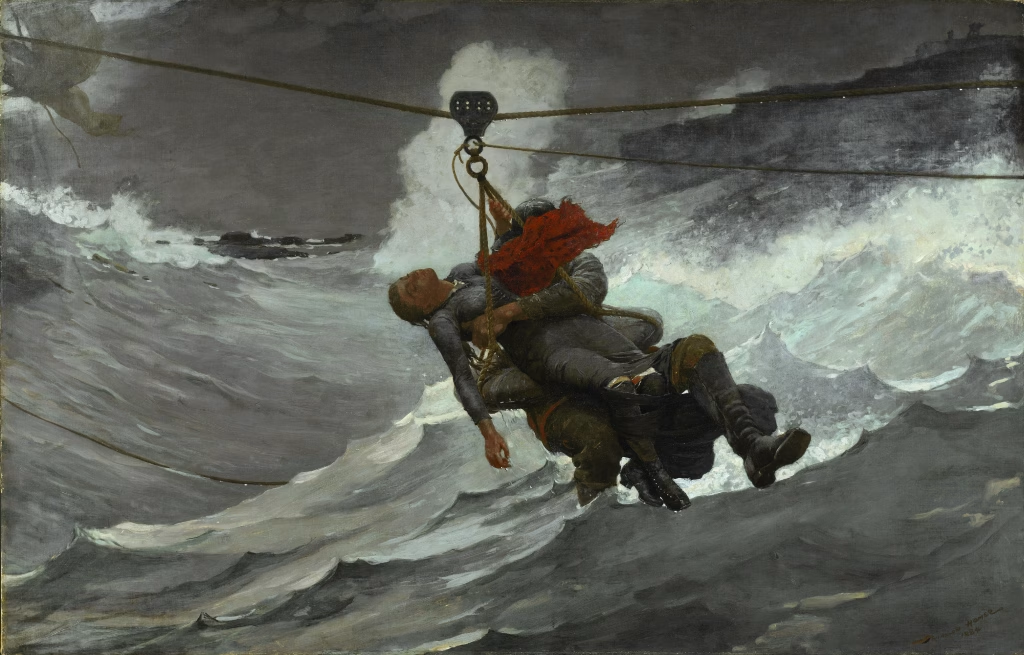
A taut line of rope stretches across the upper register of Winslow Homer’s Saved (1889), an etching made during a period of experiments in printmaking he undertook in the second half of the 1880s. On view in an exhibition at Maine’s Portland Museum of Art (PMA) dedicated to this brief but significant period, Saved is a reworking of his hit oil painting The Life Line (1884) that pares down the earlier canvas to enhance the drama of a rescue at sea. The painting included a billowing sail from the distressed ship against a backdrop of the stable ground of shore. An initial etching hewed more closely to the original, but in Saved, it’s only the rope line that supports the unconscious woman…
Titled “Winslow Homer: Painter, Etcher,” this exhibition begins from a familiar place: Homer’s earliest work in print, including the Civil War reportage published in Harper’s Weekly that made his name. But while Homer left what he called the “treadmill existence” of commercial illustration and promised to make his living from painting in 1875, his return to printmaking in the 1880s shows he remained open to working in a variety of media from both artistic and market-driven perspectives.
More ways to use this
Open on another device

Scan to open this page. Your saved notes and account access are not included.
 Long Lost Nathan Fielder movie found and posted online after nearly 20 years. (Love and Cameras in America [2008])